REVIEW · TAIPEI
Taipei Scavenger Hunt and Sights Self-Guided Tour
Book on Viator →Operated by Explorial · Bookable on Viator
Taipei turns into a puzzle trail. This self-guided walking scavenger hunt uses the Explorial-App to guide you through major landmarks and off-the-radar stops while you solve riddles, answer questions, and chase playful photo prompts.
What I like most is how you move at your own pace. There is no hard time limit, and you can pause for breaks, linger for photos, then jump back into the game when you feel ready.
One consideration: the experience averages about 1–2 hours, so if you’re craving a long guided day, this can feel a bit short. The upside is you get a structured route without committing to a full morning or afternoon.
In This Review
- Quick hits before you start
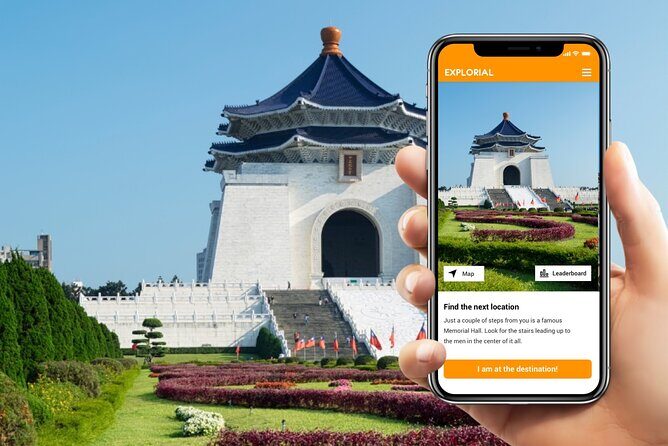
- Starting at Chiang Kai-shek Memorial Hall: where your hunt begins
- The Explorial-App method: find, follow, solve
- The route’s headline sights: Presidential Hall Plaza and The Red House
- Question tasks: learning by looking, not reading a script
- Photo challenges: the fun side of city sightseeing
- Walking at your own pace: ideal for a laid-back morning
- Who this Taipei scavenger hunt fits best
- Price and value: is $10.53 worth it?
- What to bring and how to play smart
- Itinerary feel: what the hunt really does for your Taipei day
- Should you book the Taipei scavenger hunt?
- FAQ
- How long does the Taipei scavenger hunt take?
- Where does the tour start and end?
- Do I need to speak Chinese?
- Is this a guided tour or self-guided?
- Is there a strict time limit to finish?
- What is the cancellation policy?
Quick hits before you start
- Clues lead the way so you are not stuck wandering or guessing
- Questions are answerable on-site using signs, pictures, and what you can see
- Photo tasks earn points and help you notice details you might otherwise skip
- Pacing is flexible with breaks built in and no strict finish clock
- You play with your own group in a private setup (no joining strangers)
- A low price for an app-led adventure keeps it easy to try, even if you are budget-minded
Starting at Chiang Kai-shek Memorial Hall: where your hunt begins

Your journey kicks off at Chiang Kai-shek Memorial Hall, and it ends back at the same meeting point. That round-trip format is useful in a big city because you never feel lost at the end—you know where to circle back.
This area also makes sense as a starting point because it is a major Taipei landmark with lots going on around it. Even if you arrive with only a vague sense of the neighborhood, the memorial zone gives you a clean reference point before the app sends you outward.
Timing is flexible. The listing shows the memorial area open daily (listed as 12:00 AM to 11:30 PM), so you can fit the hunt into a variety of schedules as long as the app experience works for your start time.
You can also read our reviews of more guided tours in Taipei



The Explorial-App method: find, follow, solve

You do not meet a guide or join a group with a rigid itinerary. Instead, you buy your ticket, then receive an access code you enter in the app to start playing.
From there, the experience uses three core mechanics:
- Hints and a map function to help you get to each location
- On-site questions that you answer once you reach the spot
- Photo prompts that challenge you to get creative
The map guidance matters because Taipei can be easy to navigate, but still confusing if you do not know which streets connect where. Here, you get a built-in route finder, but you still retain control over when you walk, when you stop, and how fast you move.
The other big plus is that this is not limited in time. That changes the feel completely. If you want a laid-back morning, you can stretch the walk with breaks. If you are moving quickly, you can finish sooner than the average.
The route’s headline sights: Presidential Hall Plaza and The Red House

The hunt is designed to mix well-known Taipei stops with places that feel more like you found them by accident. Along the way, you may reach standout locations such as Presidential Hall Plaza and The Red House, plus additional stops signaled by your clues.
How you use these stops is what makes it different from a normal visit. You are not just looking at buildings and moving on. You are arriving with a purpose, then answering questions that push you to look closer than you would on autopilot.
For example, questions are often tied to details you can spot in the environment—signs, pictures, and visual info near the sight. That means you are engaging with the place in real time, not memorizing facts from a screen.
One more practical benefit: big landmarks like Presidential Hall Plaza usually have clear surroundings and lots of foot traffic, so it is easier to regroup if your group splits into two or you want a quick snack stop.
Question tasks: learning by looking, not reading a script
A normal tour tells you what to notice. This hunt makes you do the noticing yourself.
When you arrive at a clue location, you are asked questions about the sight. The answers are usually visible right where you stand, often hidden in signs and pictures you would pass quickly if you were only sightseeing.
That is a smart way to learn because it turns the city into a living textbook. You are not just hearing facts—you are locating them, which helps the information stick.
This format is also a good fit for different travel styles:
- If you like structured activities, you get a clear sequence of tasks.
- If you prefer wandering, you still have a reason to move from one location to the next.
And because the questions are tied to what you can see, you do not need specialist knowledge to succeed. You just need patience and a willingness to look around.
Photo challenges: the fun side of city sightseeing

One of the most playful parts is the photo tasks. The app includes creative prompts, and they can range from simple picture ideas to challenges that make you think outside the obvious framing.
You earn points when you do well with the snapshots, so even if you do not consider yourself a photographer, you still have a reason to try. In practice, this is a nice way to add energy to a walk, especially if you are traveling with kids or teens who might get bored with pure sight-detail tours.
There is a balance here: if you hate the pressure of creating perfect photos, treat the tasks as light prompts rather than a performance. The point is to engage with the city, not to win an art contest.





Walking at your own pace: ideal for a laid-back morning
The whole experience is built for flexible pacing. On average it lasts about 1–2 hours, but the listing notes it is not restricted by a strict finish time.
That makes it especially good when you want to start the day with something structured, but not exhausting. One review-style theme that stands out in the feedback is how people enjoyed the laid-back rhythm. You get movement and variety without the sprint-and-finish feeling of a typical group tour.
It also works if your group has mixed energy levels. You can slow down for photo moments, take a break, or pause to grab something to eat mid-walk. Then you can jump back into the game without worrying that a guide is waiting for you.
Who this Taipei scavenger hunt fits best

This is a great pick if you want Taipei to feel active instead of passive.
I think it works well for:
- Families looking for a shared activity that still includes real sights
- First-time visitors who want a guided route but prefer to go at their own speed
- Couples or friends who like light competition, team play, and playful tasks
- Solo travelers who do not want to join a large group
One thing I also appreciate from the overall vibe: people often like it because it is a new way to explore when they have not tried a self-guided walking game before. It feels approachable, not technical or intimidating.
Because it is private for your group, you are not stuck matching a stranger’s pace. That can matter on a walking experience, especially in a place with crowds around major landmarks.
Price and value: is $10.53 worth it?
At $10.53 per person, this is priced like an easy-to-try activity rather than a premium guided tour. For that money, you’re not paying for a human guide’s time. You’re paying for a structured route, clue design, and the app-based interaction.
So the value depends on what you want. If you like hands-on activities—solving questions, hunting for visual answers, and doing photo prompts—this can feel like a bargain. Multiple high marks focus on value and the fact that it delivers a fun mix of sightseeing and learning without demanding too much effort.
Where the value really lands is in the combination:
- You get a walking route that hits recognizable places
- You get tasks that turn those stops into something you actively do
- You get control over time and pace
The one warning sign is if you dislike scavenger-style activities. If you want a traditional lecture or lots of deep storytelling, this might feel too game-like and a bit short.
What to bring and how to play smart
Since this is app-led, your basics matter. You should be ready to use your smartphone for navigation, clue reading, and photo tasks.
Practical tips I would follow before you start:
- Charge your phone or bring a power bank if you think you might use navigation a lot
- Wear comfortable walking shoes, since it is a walking tour even with flexibility
- Bring a small water plan, especially if you are stretching it near midday
- If you are traveling as a family or group, decide early if you want to split into teams or stay together
Also, remember the access code. Keep it accessible after purchase so you can enter it smoothly in the app when you reach the starting point.
Itinerary feel: what the hunt really does for your Taipei day
Even though the walk is organized into stops, the experience feels less like hopping between checklists and more like following a chain reaction. You start at Chiang Kai-shek Memorial Hall, then you keep moving because the next clue is waiting.
As you go, the game nudges you to notice details. Questions are often tied to the physical environment, so you end up paying attention to signage, imagery, and sight specifics that you might otherwise treat as background.
And because you get points for photo tasks, the walk has built-in momentum. You’re not only walking for exercise or only walking for photos—you are walking because you have a mission in both directions.
If you love Taipei for its mix of grand architecture and everyday city life, this style helps you see both. Big official-style landmarks catch your eye first, but the clue flow can pull you toward lesser-known corners where the city feels more personal.
Should you book the Taipei scavenger hunt?
Book it if you want a low-cost, app-led way to see major Taipei sights while still feeling in control. It is especially compelling if you like puzzles, photo prompts, and learning through looking at what is right in front of you.
Skip it if you want a long, guided day with extended storytelling and a deep dive into every stop. The average run time of about 1–2 hours makes it more of a smart add-on than a full replacement for a classic tour.
If you are unsure, I’d treat it like a perfect first experiment. Starting at Chiang Kai-shek Memorial Hall keeps things easy, the app handles wayfinding, and the flexible pacing helps you fit it into real travel rhythms.
FAQ
How long does the Taipei scavenger hunt take?
It lasts about 2 hours on average, and the experience notes an average duration of roughly 1 to 2 hours.
Where does the tour start and end?
It starts at Chiang Kai-shek Memorial Hall and ends back at the same meeting point.
Do I need to speak Chinese?
No. The tour is offered in English.
Is this a guided tour or self-guided?
It is self-guided. You download the Explorial-App, use your access code, and follow clues on your smartphone.
Is there a strict time limit to finish?
No. The experience is not limited in time, so you can explore at your own pace and take breaks.
What is the cancellation policy?
You can cancel for a full refund up to 24 hours in advance. If you cancel less than 24 hours before the start time, the amount paid is not refunded.